Click on above ad for more information
Showing posts with label Gardening. Show all posts
Sunday, March 20, 2011
CATTLEYA IN BLOOM
It is that time when Cattleyas are in bloom............All week my purple Cattleya has been it it's glorious perch. Not that I knew it was coming. I was about to leave for work last Monday when I noticed the three lovely blooms in full glory.
I had bought three different Cattleya pseudobulbs at an International Orchid Show in Shah Alam some years back. These days they organise them in Putra Jaya. The three I bought were of yellow, purple and white Cattleya and each pseudobulb cost a mere RM10 back then. In buying a whole pot the number of pseodobublbs would be counted and costed accordingly!
The yellow and purple ones have given me many happy moments. Unfortunately, the white Cattleya never made it............
Cattleya gets it's name from William Cattley. It is known for it's large showy blooms which are sometimes fragrant. As I have a perpetual sinus, I have never ever been able to detact the fragrance though. When in bloom, water needs to be reduced to avoid rotting the flowers. Because of their ease of growth and sheer beauty, cattleyas are the most hybridized of all orchids. There are thousands upon thousands of registered hybrids. So, if they are not tagged when you get them be extremely careful in giving them an ID.
Friday, October 08, 2010
Garden Plants : Lilies
Over the years I have nurtured various plants in my garden for added exercise and recharge of the essence. I usually select plants that are easy to grow and manage. In this series, I would like to share some of my experience with them and the images I have saved up in my archive.
Liliaceae is a family of lilies. There are so many varieties of species and hybrids that many of them may have been reclassified. I am putting them here together for convenience. They are rather easy to grow....especially the Asiatics or Orientals. There are very few pests that challenge them apart from the odd slug .......in fact some may even be poisonous and are no good around cats. Lily flowers may be (a)tubular (trumpet- shaped), (b)bowl-shaped or (c) turban-shaped (Turk's cap). There are usually about 3 - 4 flowers on a stem holding themselves upright, facing upwards, downwards or nodding. Some may even be fragrant. Leaves are mostly linear growing from bulbs. Propagation is generally by division of the bulbs.
The colour white is often associated with lilies. Legends and folklore abound about this symbol of innocence and hence you may find white lilies placed on graves/tombs of those committed of crimes they didn't do and in bridal bouquets. They may also appear as the symbol of mourning, glorification of the dead. Of course lilies come in different colours
I inherited the above white , bowl-shaped lily from my late mum. No one else wanted them after she passed away. I didn't think it was a lily initially, until I had a closer look at the blooms.
I bought the red Amaryllis above from the Jaya Superparket in PJ some years back. It is of Dutch origin. It is usually identified by it's two-ranked leaves. To encourage the flower stem to grow upright, I would recommend to grow it in the sun. Being of dutch origin, I made a mistake of growing it in a shaded area ....it never produce any more flower. So, one day I tried putting it in the sun and true enough it began to bloom. The flower stem and leaves are cut back at just above the bulb once the blooms have dried up.
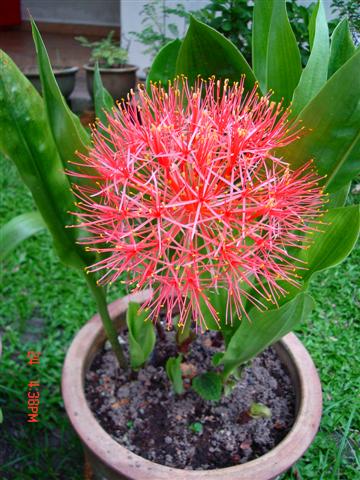
The above variety is the Allium.....same genus as onions, chives and garlic. Indeed they are often called blooming onions. It has 4-6 base leaves and requires full sun. The bulb may grow to quite a size and do remember to give it ample space during re potting. The flowers are rose pink florets forming a pompom-like flower-head. It is often described as a firework frozen in mid-explosion.
Flowers may come in different colours too ranging from white, green, yellow, blue and purple. Some bulbs may not be so big while some are, like the gigantum varieties. Again , once the bloom is completed, the whole stem is to be cut back.
| Some of the florets are not open yet |
| All florets are opened |
Tuesday, September 07, 2010
MY CATASETUM IS IN BLOOM AGAIN!
| @ 07-09-10 |
| Repotting |
Three of the pots have produced spikes since a couple of weeks ago and I reckon I would be having an interesting Hari Raya this year observing and admiring them develop.
| Catasetums With Spikes |
When I first had the Catasetum, I just hung it under my orchid stand where it received quite an amount
of light. It had been producing female flowers that look bulbous much like the bishop's hat! (See pic #5). My first spike produced only two or three blooms of green and brown hue. I have never seen such flowers and I thought they were rather strange looking.
| Catasetum - Female Flowers |
Catasetum is the most interesting of the deciduous orchid genus. There are over 100 species which are native of Mexico to Argentine and Peru. It is a sympodial, epiphytic plant. I grow mine in pots with broken bricks and charcoal as medium. I do not know it's species but it does have a strong semblance of the Catasetum expansum. The interesting thing about Catasetum is it produces separate spikes of male and female flowers. It is seldom hermaphrodite or produce perfect flowers. The male flowers can eject pollina up to 8 ft.
| Catasetum Spike |
The fleshy pseudobulbs are deciduous inferring to a need for care in watering and it's dormancy requirement. It will lose it's foliage, usually about 6-8 leaves, after completing the flowering cycle. New pseudobulb will grow from the base. Regular watering and weekly fertilising with 20-20-20, N-P-K content is recommended. Note that different medium may require different type of fertilizer. For example, if a tree bark is used it is recommended to use 30-10-10 fertilizer. While brighter light produces more vigorous growth and better blooms, it tends to produce female flowers. A shadier environment would produce male flowers.
Note : I have had confirmation that the above orchid is actually Catasetum pileatum.
Monday, July 26, 2010
THE KINTA WEED : WHICH IS IT??
My Dad was posted to Ipoh in 1958, We stayed in 3 different houses there. The first one was in a housing trust at Jalan Kampar, the second being a staff quarter at Kg Simee Road and the third also a quarter at Jalan Abd. Jalil, Greentown. Ipoh Town is situated in the renown Kinta Valley much famous for its tin mining . Once on a car trip dad pulled over to the roadside to show us the Kinta Weed, a wild orchid that grow terrestrially in utter abandance even by the roadside. I believe mum did take a plant or two to cultivate in her garden. I understand today they are no longer seen in such abundance from the highway.
Today, reading the various write-ups, I realise some people are claiming either the Arundina graminifolia or the Papilionathe hookeriana and even Vanda hookeriana as the Kinta Weed. We are talking about the Kinta Weed and not a Kinta Weed!
![]() |
| Arundina graminifolia
by courtesy of Martin Lee
|
![]() |
| Arundina Clump
from rareflora.com
|
I have always held the Arundina graminifolia (grass-leafed) as the Kinta Weed. That was the one my dad had shown to me before. It is also commonly known as the Tapah Weed, Bamboo Orchid or Okid Buluh in Malay. It is so called because of its plaited linear leaf structure. It's new species name is however bambusaefolia (bamboo-leafed) .It is a terrestrial, perennial and has reedy stem often growing in clumps hence, I thought, giving it the weedy outlook. The flower, normally about 9 cm, reminds me of the Cattleya. However, it does have a poor flowering capacity.
![]() |
| Papilionanthe hookeriana
from forum.theorchidsource.com
|
On the other hand, Papilionanthe hookeriana, a monopodial has tereted (rounded) leaves and according to some writers, thrives in water and some claim it to be semi aquatic. This comes as a surprise to me but yes, some orchids do thrive in marshlands and it's secret lies in it's ability to adapt. In my search for truth I found that some find that it hates to get it's "feet" wet. It actually perch on other aquatic plants to stay above water. This is confusing stuff!
Apparently, confusion over what is Kinta Orchid, Kinta Weed, Tapah Weed even ruled the parliamentary debate of June 1961 in the search of Malaysian national flower.I thought it was aptly expressed by the member from Larut Selatan, Dr Lim Swee Aim:
"In fact, those of us in Perak who know orchids the rest of Malaysia apparently do not know what orchids are in Perak know that that Anggerek Kinta is Tapah Weed or to give it's proper name Arundina bambusifolia. So, there is always confusion as to what is Tapah Weed and what is Kinta Weed and which is Anggerik Tapah and which is Anggerik Kinta. Only connoisseurs of orchids will be able to tell the difference."
![]() |
| Vanda Miss Joaquim
from amassia.com.au
|
Unfortunately , he did not make it any less confusing by declaring that Kinta Orchid is Vanda hookeriana which in fact is a hybrid of Vanda teres x Papilionanthe hookeriana of which Vanda Miss Joaquin is a byproduct. Vanda Miss Joaquin later became the national flower of Singapore in 1981. It is named such as it was first discovered in Agnes Joaquin's garden in Singapore in 1893.
Tuesday, July 13, 2010
Orchids : A Housewife's Hobby
I cultivated my interest in orchids by watching my mum tending her modest collection . It was something she, her sisters and mother shared. She started going into it seriously when we were staying in Ipoh in the late 50s where the quarters we were staying in Jalan Abd Jalil, Greentown had a very large compound. I remember, while dad had his vegetable patch, mum had her cactus and orchid collections. Both of them would labour on ends to tend to their hobbies. When dad got transferred to Malacca later, mum had her orchids transported by train!
With about 25,000 recognised species, it is about the largest family (Orchidacea) of flowering plants. It is also the most diverse with about 100,000 hybrids being created in the last 150 years. W.Malaysia has more than 150 genuses and 800 wild species. Sabah and Sarawak has about 2000 wild species.
Amongst the popular orchids in Malaysia from the genus Aranda, Dendrobium, Mokara and Oncidium. If you buy your orchid plants from the nurseries, they are very likely to come with labels - Genus and Species of the orchid. Otherwise, you may just be contented to know their genus.
There are two broad categories of orchids according to their physical look:
1. Simpodial - consisting of pseudobulbs which flowers when mature. Once the bloom dries up the bulbs would soon follow suit and die. New bulb would grow from it's base. Repotting may be required every 2 years or once it has outgrown the pot. At this time you may split up the bulbs for propagation.
2. Monopodial - plant consist of a single stem with leaves on opposite sides growing upright . There are two types of leaf - strap and terete (rounded) . With new hybrids semi-terete and quarter-terete are also available.
Propagation is by making cuttings.
Orchids are also classified according to their growing habits.
1.Terrestrial - They have underground tubers and grow in the ground.
2. Epiphytic - They live on trees as air plants, not parasitic. They use trees for height to get light. They are most common in warm climate where their roots are not in danger of freezing.
3. Lithophytic - They live on rocks
Epiphytes and lithophytes are usually treated in the same manner in home gardening.They are grown in pots using broken bricks and charcoal as the growth medium.
Here are some of the orchids which have been in my collection and have graced our little garden with their blooms at one time or other.
Simpodials:
Catasetums : Epiphytic.
A most interesting genus of all. Unlike others which are hermaphroditic, it bears only male or female flowers. By varying the amount of light, I was able to produce either male or female flowers. Male flowers are produced when there is less light. The male and female flowers are distinct The male flowers are so gorgeous while the female flowers are identifiable by their bishop hat-like shape.
Catasetum. - Male Flowers
Catasetum - Female Flowers
Cattleyas: Epiphytic. 25% - 50% shelter.
Most beautiful and flamboyant genus. Very popular and has numerous hybrids. Though South American in origin, the name is taken from the man who first succeeded in cultivating it in England. Hybrid blooms are usually in bunches of 4 or 5 flowers.
Yellow Cattleya
Cattleya loddigesii
Purple Cattleya
Purple Cattleya
Oncidiums: Epiphytic, lithophytic or terrestrial. 60% light.
Coelogynes : Epiphytic.
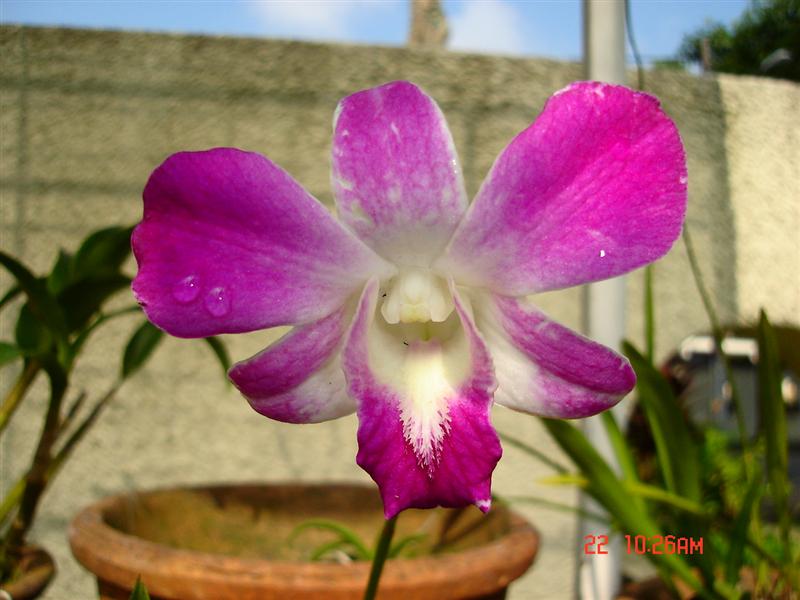
Dendrobiums : Mostly epiphytic.
Monopodials:
Arandas : Aracnis X Vanda
Ascocendas : Ascocentrum X Aerides
Mokaras :
Arachnis X Ascocentrum X Vanda, or
Arachnis X Ascocenda, or
Aranda X Ascocentrum, or
Aranda X Ascocenda .
Vandas : Epiphytic or lithophytic.
Phalaenopsis : Epiphytic or lithophytic
A lovely genus and is often referred as moon orchid, moth orchid and butterfly orchid.. Flowers can last a month!
The most sensitive part of the orchid plant is the root. As such much care is required to ensure roots are not too damp all the time least they would rot. So this is where the growth medium becomes important. There are also other considerations necessary for good plant growth like light, shelter, watering, fertilising and pests.
Fertilisers are usually composed of nitrogen (N) for growth, phosphorus (P) for rooting and flowering and calium (K) for flowering, and magnesium (M) for general health. So a general understanding of the contents of the particular type of fertiliser being used will help to maximise it's use. For example, for matured plants you need a well balanced fertiliser. Check the package for the ratio of contents. For young plants you would require a higher content of N. There are various types of fertilisers in the market : chemical, organic and commercial.
As I grow my orchids outdoors, the most daunting for me has been the pests especially ants, yellow beetle and to some extent, fungus. Yes, they are sap sucking and can even eat up the whole bud or flower. Not wanting to use too much poison, I have resigned to using the water based insecticide aerosol which is most handy. Do note that orchids may also be affected by virus and bacteria. Occasionally I give the plants a good bath in a solution of Captan, Maneb or Thiram.

Subscribe to:
Posts (Atom)