Click on above ad for more information

Tuesday, May 25, 2010

THE FLOOD OF '57


Being brought up in Malacca and having lived in Kuala Lumpur, Penang and Padang Besar, I had never seen a flood. This was about to change. There were many firsts during my two years sojourn in Kota Bahru, Kelantan where my dad was posted to.

For some reason, my elder brother did not follow in the move. I always thought that it could be due to his Standard 6 exam but then it was not to be in a few years time. So, there we were, just my parents, younger brother and I making the move. We traveled to Kota Bahru by train, the Malayan Railway. The journey was not without it's tense moments as we were actually traversing communist infested jungle areas. Once the train actually stopped somewhere to await for another train to pass and I noticed the urgency in the guards checking all the doors. Some of you may even recall that the last carriage usually carried guards and soldiers. All being well then, we were met at the Kota Bahru Railway Station by a staff who then took us across the Kelantan River by ferry and then by a Land Rover to our quarters. You see the town was across the river from the railway station. My elder brother would come to visit us during the school holidays.

In the East Coast the monsoon would hit long and hard. I had never seen anything like it before. The rain would last a week or so. Then, a short pause and the rain would start again, never really stopping. Makeshift clothes lines were made indoors for the washings. After a week the grass would turn yellow due to lack of sunshine. Rivers would start swelling up and all low lying areas would soon become underwater. We were fortunate that the quarters area was on high ground. Our neighbours were not so lucky. By then,  they must have been so used to the annual weather change. They even had a boat handy for transport to the front gate and hence the main road. I once took a boat ride to inspect the area behind their house. It was then that I knew there was a river back there. No wonder the place was always flooding!

We were told that Kelantanese enjoy the floods. They, especially the young maidens, would come out in nice clothes to play in the flood waters. It was said that that would be a very good opportunity for girls and boys to meet or see one another and foster some hope of matrimony. As "outsiders" we found this rather amusing, dangerous and err...a health hazzard!

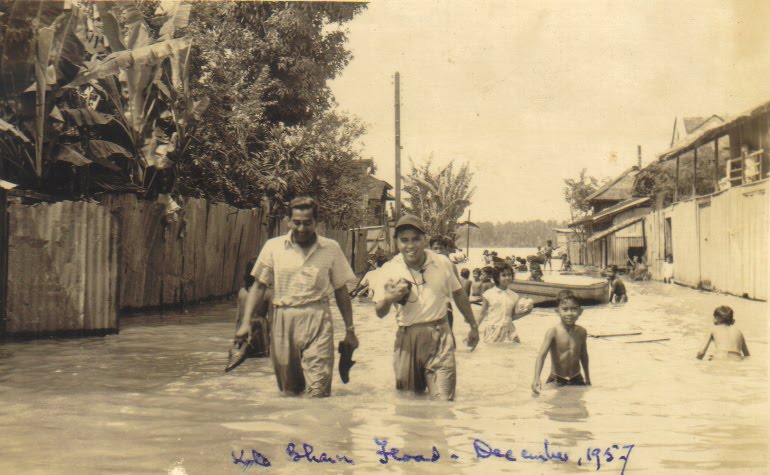
The above picture shows my dad, younger brother (shirtless) and myself accompanying my dad's friend, Uncle Ibrahim (with shoes in hand) out from his abode. He had become stuck at home due to the flood. I am further behind with some stuff in my hand.

Now I know why Kelantanese traditional houses have very high stilts.

Friday, May 21, 2010

A LOVELY STORY

A friend sent me this story. I thought that it is so lovely that I ought to save and share it. Enjoy it:

BURNT BISCUIT

Mom liked to make breakfast food for dinner every now and then. And I remember one night in particular when she had made breakfast after a long, hard day at work. That evening, mom placed a plate of eggs, sausage and extremely burned biscuits in front of dad. I remember waiting to see if anyone noticed.

All dad did was reach for his biscuit, smiled at mom and asked me how my day was at school. I don't remember what I told him that night, but I do remember watching him smear butter and jelly on that biscuit and ate every bite.

When I got up from the table, I remember hearing mom apologize to dad for burning the biscuits. And I'll never forget what he said:
"Honey, I love burned biscuits."

Later that night, I went to kiss Daddy good night and asked him if he really liked his biscuits burned. He wrapped me in his arms and said,"Your Momma put in a hard day at work today and she's real tired. And besides - a little burnt biscuit never hurt anyone!"

"You know, life is full of imperfect things.....and imperfect people. I'm not the best at hardly anything, and I forget birthdays and anniversaries just like everyone else."

"What I've learned over the years is that learning to accept each others'faults - and choosing to celebrate each others differences - is one of the most important keys to creating a healthy, growing, and lasting relationship. Because in the end, you are the master of your own life, to be happy or unhappy, to be positive or negative."

We could extend this to any relationship. In fact, understanding is the base of any relationship , be it a husband-wife or parent-child or friendship.

Don't put the key to your happiness in someone else's pocket - keep it in your own.

So please pass me a biscuit, and yes, the burnt one will do just fine ...

Wednesday, May 19, 2010

TINY FLOWERS

It would appear that if you are small, people tend not to notice you so much. I have these pictures of the little, tiny flowers that bloom away relentlessly and yet virtually unnoticed in my garden and elsewhere, kept away in my picture archives for years. Today I am dedicating this write to them, those that have stood up like sentinels both sides of the pathways, the lawns as well as every nook and cranny....


The first one is a wild orchid which I had saved from a huge tree in front of the house. So, it is not truely wild now. I believe it is an Acriopsis. It has real tiny white petals with purple tips. The flowers may last for about a month which is good by any standard. Indeed, some orchid blooms are known to last that long.


The red and yellow flowers next are actually not so small but still very few people would have cared for them. The pictures were taken while on a trip back to my late mum's dusun (fruit plot) in Kelemak, Malacca. I think they are gorgeous. I would be happy if anyone could identify this red flower. Upon maturity, the center part would open up to reveal and scatter the seeds within.


The Malays call the yellow flowers Simpoh Air scientifically it is known as Dillenia suffruiticosa. I have never found out what "simpoh" means. As such I suspect it may be a local dialect to mean "simbah" (pour) and pour water does make sense anyway. This attractive shrub can grow up to 7 metres tall. The large robust leaves were commonly used before the days of plastic and styrofoam as disposable platters and wrappers to wrap 'tempeh'(soya cake) and 'rojak'(local salad). Apparently the plant can live to 50-100 years!I think I may need to check on this further!!


Next, the lovely pink flowers are from my starfruit tree. I notice there is always a bunch of blooms up the tree. My brother gave me the grafting many years ago. His tree had long gone but mine still thrives without much ado, really. It sure is a hardy tree! No wonder the locals call it Belimbing Besi (Iron Starfruit).


The small white flowers with a tinge of purple are Cordia cylindristachya, commonly known as String Bush. The plant grows everywhere in my garden so much so that I simply refer them as weeds. They grow back after every weeding. You can't really win with them. So, I now take a different stance on it - a motivation for exercise and gardening. They are actually quite beautiful plants growing up to half meter tall forming a cushy carpet if allowed to thrive.


The plant of the tiny while flowers at the axils is a herb known as Andrographis paniculata. The Malays call it Hempedu Bumi (Bile of the Earth)/Pokok Cerita (Plant of Tales) while other locals call it the antibiotic plant. It is indeed the king of bitters. The leaves are used to make tea and is reported to possess astringent, anodyne, tonic and alexipharmic properties and is helpful in dysentery, cholera, diabetes, influenza, bronchitis, piles, gonorrhoea, hepatomegaly, skin disorders, fever and worm infestation , to name a few. Now you know why my Chinese friends call it the antibiotic plant!The plant grows in every nook and cranny in my garden.

Mimosa pudica or locally known as Semalu ("malu" means shy) is also known as touch-me-not. When the leaves are touched they will just retract and fold up. The plant is prickly and a nuisance in the garden. My hubby usually uses the pliers to pull them out of the ground A native of tropical America, I understand (Gosh, how did it get here, I wonder?) It has pink or almost purple flowers looking very fluffy.


The next few flowers are more of grass and weeds often found in my garden. It would probably take me some time to identify them so I am posting them here to give an idea of how many types there are out there in any garden if one care to look around. The shots were taken as best as I could with just an old, ordinary digital camera - Sony Cyber-shot, our very first one, then.

The thistle-like flowers come in white and purple in colour on every plant.


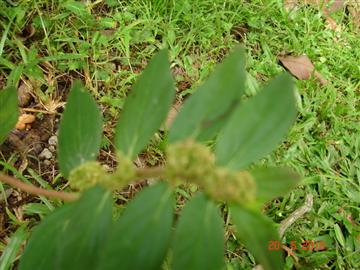
Next is the Kemuncut which I would love to call forget-me not though it really is not. It grows in every open ground. We use to pull the plant out every time we see one in the ground least we would trample on them. The spike would stick to our clothes and time and again we would have to pick them out individually.


Monday, May 17, 2010

BOOK REVIEW : THE THIEVES OF RIYADH

The Thieves Of Riyadh The Thieves Of Riyadh edited by Haroon M Jadhakhan


My rating: 3 of 5 stars
Even if half the revelation is to be taken as true, it is still most disturbing.......

It is a collection of articles from the Muslim Chronicle whose address is in London. I am old enough though to have read some of the older issues in the daily papers during my London days.

The heart of the book is in the revelation of the conspiracy against Islam the biggest agent being a group of people within the Muslim community itself. They are described as wealthy, so wealthy that you and I may not be able to imagine, powerful, bloodthirsty, moronic,degenerate etc...etc...Issues cover a broad spectrum from money extorted from Hajj pilgrimage, child jockeys (a practice which had been banned in the UAE since 2002. Thank God) child "brides" who were actually slaves of a kind, BCCI incident, excesses of the rich and powerful.......while millions of Muslims in Africa and Asia are in gross situation. To cap it all, the book explains why there will be no solidarity in the subcontinent unless...........

View all my reviews >>

Friday, April 23, 2010

CASE OF THE STAR ANISE


We are often held in awe to note what modest stuff may really do for mankind. I always keep a bottle of star anise on my spice rack. What Malaysian housewife won't, anyway. I use it for fish curry and briyani rice that's all.I guess that speaks of my culinary prowess. It would appear that the Chinese, Vietnamese and Indians do find a multitude of use for it in their food preparation.

Recently, it came to my knowledge that apart from it's culinary uses, the Chinese and the Indians have long been using it for medicinal purposes. For example, I now recall the anise seeds served in Indian restaurants after meal to aid digestion. In Traditional Chinese medicine, star anise is used as a warm and moving herb that assists in relieving cold-stagnation in the middle jiao.

In 2005, there was a temporary shortage of star anise due to its use in making Tamiflu. The 2009 swine flu outbreak led to another series of shortages as stocks of Tamiflu were built up around the world, sending prices soaring. Wo.......that is news to me! Tamiflu is a trade name for Oseltamivir, an antiviral drug that slows the spread of the flu virus in the body. Unfortunately, as of April 2010, the World Health Organization (WHO) reported that 268 out of over 15,000 samples of the prevalent 2009 pandemic H1N1 (swine) flu tested worldwide have shown resistance to oseltamivir. Noted as well are the political figures who served on the board of the producing company.

Back home, people are brewing the star anise ...........

Thursday, April 01, 2010

My Tipping Point


After several calls to the supplier and the courier regarding my long awaited consignment, it finally arrived on the evening of March 31, 2010. They were two lovely white bottles of 1 quart (approx. 944 ml) each.

Eagerly I poured out the first 2ml and took a little sip. Hmm...not bad at all. Then I passed the glass on to my hubby and then to my son to take a sip as well. I finished up the rest. About two hours later while watching TV, I felt a tingling sensation in my body much like something is "clearing up" and it felt..... relieving.

Next morning, for the first time in months, I felt no pain when taking my first step after waking up in the morning! There was a little left over sensation though, but there was no real pain of note! I know it is still early days but I am sure to keep on observing.

You see, some months ago after becoming a full time housewife, my left heel had started aching. It is specially bad after raising up in the morning in taking that first step. Hence walking and navigating the staircase became quite challenging. The doctor said it is Plantar Fasciitis, an inflammation of the band of tissue (the plantar fascia) that extends from the heel to the toes. In this condition, the fascia first becomes irritated and then inflamed, resulting in heel pain. I was given an ointment for rubbing and an oral medication,ibuprofen, also an anti-inflammatory. That suffice to keep matters under check then during my short trip to Singapore on the occasion of my nephew's wedding.

There are several symptoms of Plantar Fasciitis:
* Pain on the bottom of the heel
* Pain that is usually worse upon arising
* Pain that increases over a period of months

People with Plantar Fasciitis often describe the pain as worse when they get up in the morning or after they’ve been sitting for long periods of time. After a few minutes of walking the pain decreases, because walking stretches the fascia. For some people the pain subsides but returns after spending long periods of time on their feet.

Recommendations to patients include:

* Stretching exercises. Exercises that stretch out the calf muscles help ease pain and assist with recovery.

* Avoid going barefoot. When you walk without shoes, you put undue strain and stress on your plantar fascia.

* Ice. Putting an ice pack on your heel for 20 minutes several times a day helps reduce inflammation. Place a thin towel between the ice and your heel; do not apply ice directly to the skin.

* Limit activities. Cut down on extended physical activities to give your heel a rest.

* Shoe modifications. Wearing supportive shoes that have good arch support and a slightly raised heel reduces stress on the plantar fascia.

My right foot has also been telling me whenever my uric acid is elevated. Uric acid is a waste product normally present in the blood as a result of the breakdown of purines. Excessive amounts of uric acid can cause crystals to form in the joints and cause gout. Sometime I do get careless with my diet. I had bought some jackfruit three days earlier. Suddenly my right foot was also in pain for the two days I had been consuming the jackfruit. Upon realising it, I passed on the balance of the fruit to my son to finish off, which he did gladly. Ow...imagine both feet acting up on you!!

Imagine also a day without any pain ...

Monday, March 22, 2010

DIOXIN CONTAMINATION


A couple of days ago I received a forwarded email on a cancer update from John Hopkins University. Some people admitted that it was a hoax and that the University had never circulated such an email:

1. No plastic containers in micro.
2. No water bottles in freezer.
3. No plastic wrap in microwave.

A dioxin! Chemical causes cancer, especially breast cancer.

Dioxins are highly poisonous to the cells of our bodies. Don’t freeze your plastic bottles with water in them as this releases dioxins from the plastic. Recently, Dr. Edward Fujimoto (Wellness Program Manager at Castle Hospital) was on a TV program to explain this health hazard.

He talked about dioxins and how bad they are for us. He said that we should not be heating our food in the microwave using plastic containers. This especially applies to foods that contain fat.

He said that the combination of fat, high heat, and plastics releases dioxin into the food and ultimately into the cells of the body.

Instead, he recommends using glass, such as Corningware, Pyrex or ceramic containers for heating food.

You get the same results, only without the dioxin. So things such as TV dinners, instant Ramen and soups, etc., should be removed from the container and heated in something else. Paper isn’t bad but you don’t know what is in the paper. It’s just safer to use tempered glass, Corning Ware, etc. He reminded us that a while ago some of the fast food restaurants moved away from the foam containers to paper. The dioxin problem is one of the reasons.

Also he pointed out that plastic wrap, such as Saran, is just as dangerous when placed over foods to be cooked in the microwave. As the food is nuked, the high heat causes poisonous toxins to actually melt out of the plastic wrap and drip into the food. Cover food with a paper towel instead.


This prompted me to find out more about this substance, dioxin, and I shall attempt to record in as simple terms about what we need to know in order to keep our family safe.

Dioxin, is a class of super-toxic chemicals which are bi-products of the manufacture , moulding or burning of organic chemicals and plastics containing chlorine. It is the nastiest and most toxic of man-made contamination, second only to that of radioactive contamination!

In some countries, exposure to it is now at a serious level promising serious health effects. Exposure to it are mostly in the form of use of and contact with chemicals and plastics.

1. Chemicals such as insecticides and herbicides.
2. Plastics, polyvinyl chloride (PVC) such as in bottles, handbags, seat covers, wallpaper, plumbing pipes, coffee filters where most products are chlorine bleached.

How To Avoid Dioxin

1. Some dairy feed may be contaminated through the use of chemical insecticides. As such avoid beef.

2. Avoid bleaching products that have "chloro" as part of their name i.e. sodium hypochloride as in chlorine bleach. It looks like I would have to discontinue my Kao bleach whose active ingredient is sodium hypochloride. Use oxygen bleach instead. They release oxygen for cleaning. There are three (3) types of oxygen bleach:
- hydrogen peroxide (liquid form)
- sodium percarbonate (powder form)
- sodium perbotate (powder form)
It may cost more though and take a little more time to work.

3. Use unbleached paper products such as brown coffee filters.

4. Avoid "cling" plastic wraps unless identified as polyethlene.(So, my Giant cling wraps is alright then. However it still has a warning against use with fatty food and food with high sugar content).

5. Avoid toys made or packed in PVC labeled V or #3 plastic.

6. Wash fruits and vegetables carefully to avoid chlorophenol pesticide residue. Avoid grapes and rasins unless labled as "organic".

7. Avoid products with cottonseed oil as an ingredient e.g. potato chips as cotton is sprayed with chlorophenol insecticide.

8. Avoid soap with tallow (most soap) as it is from animal fat and deodorant with "triclosan" as it is a chlorophenol

Thursday, March 11, 2010

FORUM: MONGOL ATTACK ON BAGHDAD

Anyone knows about this event? Please detail the event here and if there is already an earlier thread please merge them.

As far as I know this event caused the downfall of the glorious Islamic Empire whose center was Baghdad. Important academic books were destroyed by the Mongol army. If that had not happened, the world would have been even more advanced as it would be in 100 years to come!

Am I right? Anyone can comment on this?


Me : I would like to contribute on this topic.

Monke who became the Great Khan after Ogedai's son, Guyuk (Great Khan for 2 years after his dad)was an expansionist compared to Ogedai. Although religious war was alien to Mongols who were generally impatial towards religions, they did hold the belief that the heaven had given them the whole world. Their objective in West Asia was the Caliph of Baghdad.

Before that they would have to eliminate all the superpowers around the region especially the Shias, such as the Ismailis who were often known as the Assassins and had settled in North and East Persia. The Mongols had received a SOS from a Muslim judge in Qazwin, a small town near Alamut(a stronghold of the Assassins). He had complained that people had to wear armour all day long for protection from the Assassins' daggers. Certainly this was a way to extract loyalty for the power of the day!

Secondly,The Mongols had news of a plan to send almost 400 Assassins to Qaraqorum, under disguise of course, to kill the Great Khan. Hulegu, Monke's brother, was the war general. Incidentally, many of his men were Buddhist and some were Christians. As such, to some of them this war also appeared as a holy war.

Nah, this news, in a way had managed to stop 40 years of civil war and unrest in Persia. Note that the Shias caused a lot of problems to the Abbasid Dynasty. The Mongols took 2 years to eliminate the Assassins .....almost completely from Persia. It's Grand Master, Rukn ad Din finally surrendered to Hulegu. Only after this he focused on Baghdad.

The origin of the word Assassin

Me : Yes, it originates from the word 'hashashashin'- those who use the drug hashish. According to tales, selected followers would be given the drug. Once they were "high" they would be given the command to commit murder - political assassination.

The expansion of the Muslim Empire is said to have reached it's height during the Umayyad Dynasty. It remained static during the Abbasid era. Only a few caliphs were real practical soldiers. Political power was more centered in Iraq. Governors in Persia were more or less left to manage their land on their own.... few respected Baghdad. In the meantime, Baghdad had become a cultural, spiritual and intellectual centre. Large mosques and libraries were filled with Arab and Persian writings. The Largest university and splendid palaces were all there.

As usual, the Mongols sent an emissary to Baghdad requesting her surrender. The request was refused. However, as other warlords have already surrendered, Hulegu and his army were able to focus 100% on Baghdad. The Christian army from Georgia had also joined forces with the Mongols making it even stronger.

At the time, Mustasim, the 37th caliph, was a young man said to be weak and whose preoccupation was in spiritualism. Court officials had exploited the situation and in fact they were the ones ruling Baghdad. They could have gathered their armies from all over their empire till which extended till Morocco, but unfortunately, Mustasim chosed his vizier, Ibn al -Alkami's advice that Baghdad's defence was adequate. At the same time, Ibn al -Alkami had sent a signal to the Mongol to attack as Baghdad's defence was in poor condition. Reference from Persian sources revealed that the reason for the treachery was that Ibn al -Alkami, a Shia, was not happy with the caliph's treatment of his fellow Shia brothers. I do not know if this story was purposely concocted to shift the blame to the Shia.

When Mustasim finally called his command to defend Baghdad, the Mongol army was already a day's march away. A contingent of 20,000 Persians left Baghdad and encamped at a nearby field. The Mongol surprised them by breaking the dams and dykes and flooding up the field. Many drowned and the rest were beheaded by Mongol cavalry.

In the meantime, Hulegu's engineers were digging trenches around the city. On 30th January, 1258, Baghdad was bombarded. All this happened so swiftly. Although the bullock carts carrying ammo from Jebal Hamrin were still 3 days away, the Mongols used whatever were available - tree trunks and foundation stones of buildings there. It took them 7 days to take control of Baghdad's eastern wall. When Baghdad's garrison finally surrendered, they were killed one by one. On 13th February, the sack of Baghdad began. It was said that the Georgian army was most keen at it. The eastern Christian community hiding in the church was saved. However the Muslim population...both Sunni and Shia....were resolved in a terrible manner. Most women, children and the caliph's treasures were sent to Qaraqorum. As for the caliph and his family, after a banquet, they were rolled and sewn up in carpets and trampled upon by horses till death. Thus ended the 500 year old Abbasid Dynasty.

Persian sources stated that between 800,000 and 2 million lives were lost in Baghdad. The smell of death was so strong that the Mongols had to camp outside the city wall. It is believed that Persian sources were exaggerated as soon after 2 years Baghdad rose again as a commercial and economic center.

Ibn al-Alkami continued in the service of the Mongol government.

Note: The Mongols believe blood had a spirit. Spilling it to the ground was a bad sign. That was why usually selected people were wrapped up in carpets before killing them so that their blood would not spill on to the ground. Of course there were other ways too.

What happened thereafter? I heard the Mongols became Muslims. Did they continue to live in Irag? There should be many decendents of Mongol in Iraq.

Me : Thereafter the rule of the Ilkhan began in Persia. It lasted for 60 years only. In the beginning, the Ilkhan were more keen towards Christianity and Buddhism. Generally, they they were oblivious towards religion until Ghazan the Reformer became Ilkhan(1295). For certain reasosn he converted into Islam causing his generals to follow suit.

After Baghdad, Hulegu prepared to attack Syria. Many Princes from the smaller principalities surrendered to him. He was now the new warloard of the realm. The Princes became Hulegu's vassals and their soldiers teamed up with Hulegu's.

I am angry at the destruction of the academic books which were of great value to mankind. Why take it on the books .....what a great loss!

Me : Mongol soldiers were illiterate and hence had little understanding of things academic. In my opinion, they had rather different mindset. Books were not assets. Their expertise were elsewhere............and mind you they were very, very good at what they were good at, considering their humble beginnings! Hulegu sent the emissary several times to Bahgdad...........from one perspective they were rather fair. However if they were insulted, then Mongol's wrath knew no bounds. I think the Caliph's refusal was mostly influenced by his vizier who had wanted to use the opportunity for revenge.

What happened after the Ilkhan Dynasty? It would appear in 1295, Malacca has not yet been established. There was just Srivijaya right?

Me : Actually, the Ilkhanate was the first Mongol nation to fall followed by China. The last Ilkhan, Abu Sa'id, did not leave a son. Mongols who did not convert to Islam left Persia while those who were Muslims got assimilated into the population. For a time Persia did not have an effective government until the emergence of a Turko-Mongol soldier from Samarqand, 30 years later(1365). His name was Timur.

Yes, Malacca was not on the map yet during the time of the Ilkhan.

The Mongols spent a lot of time fighting wars...they did not know what books to save..

Me : Also an interesting thought...

It is unfortunate that books on the Mongol history from the Mongol perspective did not survive. Hence, what we know of their history today are based on the written history of other nations such as China, Persia, Russia etc and from records of travellers of the Silk Road. Some may be bias towards the Mongols.

Many said that Islam in Baghdad and Persia could not be restored to it's original glory as many/all(?) intelectual references have been destroyed. I would like some comments on this.

Possibly the knowledge was only written in books. It would be impossible for it to just disappear if it had been practised by the general public. Not only were books destroyed, people were also killed. But then some did survive..

Me ; That is my view too. Is this a reflection of the level of their belief then?

Yes. An uncle of the Caliph survived and some members of his family did too. He was taken back to Cairo by the Mamluk and was elected Caliph there. Alas he was defeated in an attempt to regain Baghdad.

Like the sermon..??

Me : That was an illustration from Persian source....possibly from the jawi writing above it. It has been said that Genghis had listen intently to the sermons of the ulemas on the virtues of Islam. Only after that did he extol his opinion.

I'd like to emphasize that 30 years before the Baghdad incident, the Muslims had made a wrong calculation of the Mongols. Some people may not like my declaration. Nevertheless, that is a fact.

Since the beginning, the Muslim Empire of Khwarazm-Shah had diplomatic ties with the Mongols. In fact they had people with the Mongols......as spies , maybe. News of the Mongols' abilities were eye-opening. The Utrar insident in 1218 saw a Khwarazm Governor had massacred a Mongol envoy together with the Muslim caravan with him in case there were Mongol spies with them. As I have said before....Mongol's wrath had no equal......Khwarazm-Shah's Governor(also his son), Jalal-ad-Din was chased into India. The Mongols stopped at the Indus River upon hearing news of his death .... at least he was no longer a threat. His father however, was hunted into ignominy.


I Would like to ask about the terms:

A)Monggol;
B)Moghul;
C)Monggol-Tartar;

Do they represent different meaning?


Me : Mongol is a nomadic tribe of Central Asia. There were other nomadic and semi-nomadic tribes too including the Tartar, Merkids, Oirat, Naiman, Khitan, Kereyid,Ongut, Tagut, Turk, Uighur........Central Asia extends between River Onon and River Kerulen, north of the Gobi Dessert.

Moghul is a Persian word for Mongol. Specifically, the Mogul Dynasty in N. India was built by Babur who was of Mongol decent.

Mongol-Tartar is a joint Mongol and Tartar ancestry such as a Turko-Mongol ancestry.

Hope it's clear..

Misunderstanding and ill-intentions towards the Mongols.

Me : A proposal letter for trade between their people was looked upon suspiciously by Khwarazm-Shah. He regarded the Mongols as Genghis' "children". Nevertheless, there was an agreement to allow traders and merchants to pass.

The caravan which was massacred at Utrar consisted of 450 Muslim merchants from the land of the Mongols and was the first to arrive there after the agreement was sealed. After that 3 Mongol envoys ...1 was killed and 2 others has their beard burnt. As the Mongols had always treated foreign envoys well, this act by Khwarazm-Shah was taken as an act of war. In history, he was also known to be proud, self- destructive and succeeded in bringing on the terrible destruction of the Muslim world in the east.

anyone may write a book as long as he has ideas and thoughts. However, it is not within our means to decide whether the thoughts are correct or wrong. In Islam, there are guidelines to distinguish whether something is fact or fiction. For example, the English said that Francis Light was the founder of Penang ....whereas there were already settlers in Penang before Francis Light arrived. The same goes to the writings on the Mongols which you seem to be supporting...for example from Chinese and Arab sources. As for us now, we are only able to study from existing sources but we do not know if they are true. Research on knowledge are always being made in a big way....knowledge may expand in accordance with the philosophy upheld by the researchers. The West spread it's knowledge of science and technology which are based on their own philosophy. That philosophy cannot be accepted by Muslims. So, as Muslims do we have to follow them? The arts to them is infinity....but in Islam there are arts that are allowed and disallowed....

Me : It is true that history may have several versions. That is why researchers would read many sources. With my limitations,I can refer to a few only. With regard to the Mongols, it is possible that I have a soft spot for them as they cannot defend themselves......all their own sources have disappeared.....and they can only borrow information from the history of other nations. Even then, during the time of Genghis, they did not have a written language. They were illiterate. So, what's wrong in looking from different perspectives so as to establish a more balanced discussion?

Regarding Francis Light, "Founder of Penang", what you had explained is not what it really mean...

The issue of philosophy is best dealt with in a philosophy board.

FORUM : HISTORY OF THE MONGOLS


Does anyone have information on the Mongol power from the time of Genghis Khan till Kublai Khan, the land they ruled and influenced?
To me, it must have taken a great people who could expand their empire till the many corners of Asia and Europe at that time. They were also in Indonesia for a brief period. They may be looked upon as vicious, but then weren't other empires such as the Roman and even the Knights Templars in the Near East not vicious?

It is true that many trembled at the mere mention of their name.German legends had them as the lost tribe of Israel....hence giving them the reason to kill Jews at the borders accusing them of smuggling arms. The Hungarians called them dog-faced Tartars. The church thought the Mongols were related to Mogogoli, son of Magog. As for the Chinese, they had built huge walls to keep their realm safe from the barbarians. Such was their aura.

The Mongols had a humble beginning. In comparing  their achievements, one would find how impossible they appeared to be.. As such I feel there must be a lot one can learn from it's development into a nation that ruled 1/3 of the known world of the time.

In time I shall try to relate my perspective of them....

Towards the end of the 12th century, Mongol was one of the nomadic tribes that roamed high plains of Central Asia. The plains were protected by mountain ranges such as the Altai and the Tien Shan in the west, the cold Siberian forest in the north, the Gobi Desert in the south and the Kinghan Mountains in the east from outside attacks for centuries.

However, the geography of the high plains caused the tribes to constantly move in search of better weather and environment. Sometimes the tribes meet up with other tribes. The climate was extreme, life was very difficult. Horses were useful animals. Their horses were fast and strong. With their horses, they have become very skillful hunters. They:

- Invented efficient bows & amp; arrows
- Invented the stirrups. There is a possibility that they might have borrowed it from the Chinese(?)
- Were capable of using the arrows and lasso while riding very fast.

These skills enabled them to rise as a military power in the vast steppes of Asia.

It should be understood that living in the wilderness for centuries and constantly facing up to extreme climate and changes in tribal power, nomads could not build technologies, manufacture goods nor learn to mine. Hence, they became very dependent on the sedentary and civilised communities in China and Middle East. What they need they bought, traded or stole as there were very little they could trade them with except skins and woolen items.

The nomads did not see themselves as less respectable than the sedentary communities. Quite the opposite in fact. For centuries they had not accepted Chinese culture and idealogy except for some things they needed. They looked upon the Chinese as merely kneeling on the ground all their life and for that the Mongols regarded them as less valuable than the horses. The feeling was mutual. Such was the situation.

The first nomad to spread an empire was the Turks who colonised Anatolia. Then the Uighur and Khitan controlled Central Asia. Many incidents developed in Central Asia and China but the Mongols still remained as newly developed people. History of the Mongol nation began with Genghis Khan (original name was Temujin) who had filled up the vacuum when Khitan was defeated by Jurchen. Earlier, the Mongol had been living beside the Tartar, Kereyid, Merkid and the Naimans. Temijin succeeded in becoming the leader of the Mongols and later united the other tribes.

Leadership of the Mongol was passed on to the most capable in battles and other fields. Leaders who failed to show any leadership quality were ousted.

Genghis was related through his father to Qabul Khan, Ambaghai and Qutula Khan who had headed the Mongol confederation under Jin Dynasty patronage until the Jin switched support to the Tatars in 1161 and destroyed Qutula Khan. Genghis' father, Yesugei, khan of the Borjigin, and nephew to Ambaghai and Qutula Khan, emerged as the head of the ruling clan of the Mongols, but this position was contested by the rival Tayichid clan, who descended directly from Ambaghai. When the Tatars, in turn, grew too powerful after 1161, the Jin moved their support from the Tatars to the Kerait.
Here, two things are evidenced :

1. It was a traditional tactic of the Chinese, of whatever dynasty, to develop an alliance with one of the nomadic tribes on its frontier and encourage them to sow unrest amongst the remainder, should another tribe appear to be gaining an upper hand, the Chinese would abandon their ally and take up with the emerging new tribe. The purpose, naturally of course, was to foster internal strife, for as long as the tribes fought amongst themselves they are unlikely to pose a threat to anyone else.

2. Temujin's clan had provided leaders in the past. Though leadership did not pass automatically from father to son, this bred infighting which was to wound the Mongol Empire greatly later on.

As an incentive for absolute obedience and following of his code of laws, the Yassa code, he promised civilians and fighters wealth from future possible war spoils. However the exact words of the Yassa are unknown because it was never found.
Yes, Genghis Khan was a law giver. Although the original recorded early history of the Mongols did not survive, their history remain written in the history books of the Chinese, Persians, Russians, Turks and accounts of other people who have traveled to Central Asia.

The Yasa was Genghis Khan's famous code which was said to have been set down in the quriltai of 1206 and entrusted to his adopted brother Shigi-Qutuqu, a Tartar orphan, as a kind of chief justice.

It enshrine, among others:
- Mongol attitudes towards religious tolerence;
- exemption of priests and religious institutions from taxation;
- prescription of death penalty for espionage, desertion, theft, adultery and in case of merchant, upon declaration of bancruptcy for a 3rd time;
- forbidding of washing and urinating in running water as the rivers and streams were thought to be alive.

His army was also regulated.
- Military service started at the age of 14. Only physicians, undertakers and priests were exempted;
- Wives and children were expected to follow and travel with their herd to where ever he was posted;
- soldiers' tents were layed along standard lines such that they know where to find the physician's tent or the armory to collect their weapons;.
- soldiers were responsible to maintain their weapons in standard order and regular inspections were made by officers. Failure meant his dismissal;
- among other equipment included silk undershirt (arrow proof);
- the army may move in groups of 10(arban), 100(jagun = 10 arbans), 1000(regiment, minghan = 10 jaguns), 10,000(division, tumen = 10 minghans)

Genghis Khan developed a horsemen sport " the hunt" into a military drill. The exercise was usually conducted during the winter months for 3 months and every soldier took part. Another approach was to string an entire division along a line, sometimes 130 km long, and they would ride to a finishing line some hundreds of kilometres away ..............and so on. Whatever animals caught between them were killed........all to train a disciplined and skilled army..............which became a masterpiece and pride of the Mongols unequaled by any other armies in the world!

Never heard of Hulegu Khan. Who was he?
His family tree:

0. Yesugei Bar-atur

1. GENGHIS KHAN (Temuchin) b. 1167 Great Khan 1206-27

2.1. Jochi d. 1227

2.2. Chaghadai d.1242

2.3. OGEDEI, Great Khan 1229-41

2.4. Tolui d. 1233

House of Jochi

3.2.1.1. Orda (White Horde)

3.2.1.2. Batu d. 1255

3.2.1.3. Berke d. 1267

Batu and Berke united to form the Golden Horde.
Last Khan, Berdeck d. 1359.
The Golden Horde continues under other rulers from
Timurid clan.

House of Chaghadai

3.2.2.1. Baidar,

followed by the Khans of the Chaghadai
Khanate until Babur fled to India and
founded the Moghul Dynasty.


House of Ogedei

3.2.3.1. GUYUK, Great Khan 1246-8


House of Tolui

3.2.4.1. MONGKE, Great Khan 1251-9

3.2.4.2. Hulegu d.1265

Followed by Khans of the
Ilkhans in Persia.
Last Ilkhan, Abu Sa'id d. 1335


3.2.4.3. KUBILAI, Great Khan 1260-94

Established the Yuan Dynasty in China..
Last Yuan Emporer, Toghon Temur d. 1370

House of Ariq Boke

He is believed to have died without a successor.

I'd like to post something of the way of the Mongols written by Marco Polo from the Medieval Sourcebook.

"Of the wandering life of the Tartars--of their domestic manners, their food, and the virtue and useful qualities of their women.
Now that I have begun speaking of the Tartars, I will tell you more about them. The Tartars never remain fixed, but as the winter approaches remove to the plains of a warmer region, to find sufficient pasture for their cattle; and in summer they frequent cold areas in the mountains, where there is water and verdure, and their cattle are free from the annoyance of horse- flies and other biting insects. During two or three months they go progressively higher and seek fresh pasture, the grass not being adequate in any one place to feed the multitudes of which their herds and flocks consist. Their huts or tents are formed of rods covered with felt, exactly round, and nicely put together, so they can gather them into one bundle, and make them up as packages, which they carry along with them in their migrations upon a sort of car with four wheels. When they have occasion to set them up again, they always make the entrance front to the south. Besides these cars they have a superior kind of vehicle upon two wheels, also covered with black felt so well that they protect those within it from wet during a whole day of rain. These are drawn by oxen and camels, and convey their wives and children, their utensils, and whatever provisions they require."

"The women attend to their trading concerns, buy and sell, and provide everything necessary for their husbands and their families; the time of the men is devoted entirely to hunting, hawking, and matters that relate to the military life. They have the best falcons in the world, and also the best dogs. They live entirely upon flesh and milk, eating the produce of their sport, and a certain small animal, not unlike a rabbit, called by our people Pharaoh's mice, which during the summer season are found in great abundance in the plains. They eat flesh of every description, horses, camels, and even dogs, provided they are fat. They drink mares' milk, which they prepare in such a manner that it has the qualities and flavor of white wine. They term it in their language kemurs."

"Their women are not excelled in the world for chastity and decency. Of conduct, nor for love and duty to their husbands. Infidelity to the marriage bed is regarded by them as a vice not merely dishonorable, but of the most infamous nature; while on the other hand it is admirable to observe the loyalty of the husbands towards their wives, amongst whom, although there are perhaps ten or twenty, there prevails a highly laudable degree of quiet and union. No offensive language is ever heard, their attention being fully occupied with their traffic (as already mentioned) and their several domestic employments, such as the provision of necessary food for the family, the management of the servants, and the care of the children, a common concern. And the virtues of modesty and chastity in the wives are more praiseworthy because the men are allowed the indulgence of taking as many as they choose. Their expense to the husband is not great, and on the other hand the benefit he derives from their trading, and from the occupations in which they are constantly engaged, is considerable; on which account when he receives a young woman in marriage, he pays a dower to her parent. The wife who is the first espoused has the privilege of superior attention, and is held to be the most legitimate, which extends also to the children borne by her. In consequence of this unlimited number of wives, the offspring is more numerous than amongst any other people. Upon the death of the father, the son may take to himself the wives he leaves behind, with the exception of his own mother. They cannot take their sisters to wife, but upon the death of their brothers they can marry their sisters-in-law. Every marriage is solemnized with great ceremony."


"Of six successive emperors of the Tartars, and of the ceremonies that take place when they are carried for interment to the mountain of Altai........
To Chingis-khan succeeded Cyhn-khan; the third was Bathyn-khan, the fourth Esu-khan, the fifth Mongu-khan, the sixth Kublai-khan, who became greater and more powerful than all the others, inasmuch as he inherited what his predecessors possessed, and afterwards, during a reign of nearly sixty years, acquired, it may be said, the remainder of the world. The title of khan, or kaan, is equivalent to emperor in our language. It has been an invariable custom that all the grand khans and chiefs of the race of Chingis-khan should be carried for interment to a certain lofty mountain named Altai, and in whatever place they may happen to die, even if it should be at the distance of a hundred days' journey, they are nevertheless conveyed there. It is likewise the custom, during the progress of removing the bodies of these princes, for those who form the escort to sacrifice such persons as they chance to meet on the road, saying to them, "Depart for the next world, and there attend upon your deceased master," believing that all they kill do actually become his servants in the next life. They do the same also with respect to horses, killing the best of the stud, in order that he may have the use of them. When the corpse of Mongu was transported to this mountain, the horsemen who accompanied it, having this blind and horrible persuasion, slew upwards of twenty thousand persons who fell in their way."

 I am not sure of the actual Mongol names of the Khans who succeeded Genghis(Chingis) Khan as other sources mention the Great Khans to be :

Genghis (Chingis)
Ogedei
Guyuk
Mongke (Mongu?) and
Kublai

This Hulegu Khan guy, he destroyed Baghdad in 1258. With his barbaric mentality, he had destroyed many valuable books of knowledge. Hundreds of historical artifacts were also were also done with by his hands....what stupidity...
You must remember that whilst the Mongols had an expansionist policy at that time, their attack on Bahgdad was also brought on by the treachery of the Muslim Officials of the city. Had the Caliph paid more attention to what was going on with his PM, history may be different. He himself was a very weak Caliph.

(After this I left the forum. I find it strange when forumners simply cut and paste pages and pages of information without a single comment)

Tuesday, March 09, 2010

FORUM : LOYALTY

Me : Someone said it is "the holiest virtue in the human heart". It anchors a marriage and binds a friendship and yet people are saying this is a fast disappearing virtue. Is this so? If so, why?

If truly an ounce of loyalty is worth a pound of cleverness and if " it is better to be faithful than famous" - Theodore Roosevelt, AND if "those who faithfully observe their trust and their covenants will inherit Paradise" - The Quran.....

...are we then becoming less divine, less clever, having problems with our commitment , allegiance and devotion to the people and entity that we say we love such that finding worthy partners and friends may soon become a thing of the past?

Loyalty diminishes because of egotism.....

Me : That may be true...

A person's loyalty says much about that person. If you are loyal to someone, you would always preserve his/her good name no matter what. It is a moral necessity which reflects your understanding and acceptance of the person or institution you are related with.

They say a loyal person has character. Real loyalty endures inconvenience, withstands temptation and does not cringe under assault.

It is also said that only those who are special and exceptional may have the capacity to be truly loyal and true loyalty may be seen only when challenged. It would appear that many had succumbed to the challenges it attract!

Why is it so difficult to be loyal, or is being "normal" men just an excuse? After all, normalcy is supposed to be acceptable.

You say they have become more self-centered. Why have they become so?


Self-centredness is a prerequisite of survival. However, as you grow and mature, survival should also be balanced up with other values in life....

Why? Even the education system of the country recognises the limit of human IQ
which is basically hinging on the ability of the individual.

The nature of loyalty is dependency


Me : Individual achievement is important to feel good about yourself. However, loyalty may still be upheld so long as it does not compromise your honour. Otherwise it is blind loyalty. My thought reflects the Tuah-Jebat "brotherhood".

William J. Bennet suggests that loyalty needs the understanding of truth and what is right. As such, children should be educated in values which may improve the ability to think when empowered under any situation. At times young people tend to give up easily.... and they resort to becoming jumping frogs for the sake of RM100-200 more. Employers see this as a loyalty issue.


Loyalty has it's limitation... it should not be to the extent of being being led by the noose.

I do not deny it's positiveness and implications, but then at times it destroys oneself from within. It would be worst if it destroy others too. For example, blind loyalty. I think loyalty is linked to love.... we dare not confront the person whenever he makes a mistake, or worst we defend him ... all in the name of loyalty and love. In true loyalty and love one should be able to discuss such thing.

All things must have limits


Me : Thanks for mentioning this aspect, interestingly, it underlines the dependency of loyalty.

Agreed that loyalty must have it's limitations but nonetheless it does not change the characteristics of loyalty itself. It should be limited by ethics. For example, an abused wife should not allow the abuse to continue in the name of loyalty towards her husband. Loyalty ceases to be a virtue when we need to sacrifice our self respect to preserve it. This may be a little subjective as it depends on what one terms as self respect. How would you know when your self respectability is being compromised?

Only those capable of sacrifice may be loyal

Me : It is true that loyalty does have the element of sacrifice - a responsibility that transcends normal obligation whilst preserving the interest of those we have relationship with such as the husband-wife, employee-employer, citizen-nation, father-son......there will surely exist a certain expectation of loyalty, allegiance, fidelity and devotion .

It is a silent expectation.

I am LOYAL to those who deserved to be LOYAL to.
Interesting, who in your analysis should deserve it?

The thing is I am thinking that we don't necessarily give our loyalty to any Tom, Dick or Harry for no apparent reason. We give it to those whom we have come to be bonded to say, by employment or marriage, family tie or by any means of formal or informal contract.


It is something abstract, actually...can't put a finger to it...we can only follow a hunch...if we misplace it...we can always 
pull it back and give to those most deserving...most sincere...


Me : I am unsure of how to respond to this. You gave the notion that loyalty is something you may chose to give and then pull back and then give it to someone else.....You follow your hunch in this decision. Do correct me if I am wrong.

So my question would be what kind of hunch/feeling would you consider qualified for loyalty giving?

My thoughts are, once you decide on a bond or relationship with someone or entity, it goes with a commitment which, amongst others, would include an understanding/ expectation of some degree of loyalty. By an large, loyalty becomes the right thing to do and is therefore given willingly. If for some reason you find the bond no longer meaningful, then you may decide to break the bond and hence you become no longer bound to be loyal. That is why they say that the test of loyalty is when the bond is under stress. Loyalty therefore goes with the bond. I feel that it is not possible for you to remain bonded to someone and yet not be loyal to that person unless you choose not to be steadfast in your bond or attachment.

Sort of you need to test the loyalty that you give out...like Sayembara

Me : Sayembara"? What is it?

But still interesting........ Usually people would want to test the loyalty received. So what does it mean when you test the loyalty you give to others? Are you really expecting a "return" for the loyalty?

It's a contest a literary term. Nothing is 'free' nowadays, it seems...

Me : Oh thanks .....Cari dictionary says " prize contest" . Gee, it's pretty scary when I come to think of it. If you are not loyal in your friendship, what kind of a friend would that make you?


Due to a lot of bad things happenning to me in the past, my loyalty is given only to those who deserve it.

I think self-preserverence is the answer for this. Be defensive, follow your hunches and justify the badness in people, then you can get loyalty from someone


Me : Would you still remain in the same relationship as before even when you are no longer loyal to him/her/whatever?


There is no use to stay when there is nothing to commit to...I am an all-giver. If I can't be of help, I don't think I should be around at all. It would make me look useless. The same goes to him...whoever he is. my utmost strict policy on relationship is, the guy has to be super loyal and committed because i am. I may sound too firm ..huhu


Me : You make absolute sense. If you cannot commit do not get into a relationship. Any relationship demands self-sacrifice.

Hehehe... so how, while women may fake orgasm, men can fake a whole relationship!


In that case, should I say, mutual understanding? 
You do that, then I'll do this lah. Hihih, but in serious light, I see that both parties have to be clear about things like this. Communication is vital! no normal human being is born with psychic ability, especially men. Women mags have sheded some light on this and also relationship consultants have produced books to tell the public how should we do it in a most subtle way.

What do you think if, in a family situation, the mother is usually constrained to be loyal to the family only for the sake of the children when the daddy has commited adultery/affairs with another (showing he is being unloyal)....vice versa too, if the wife commits an affair with another.


Me : Generally, this calls for shared values. You know in my days the akad nikah(marriage solemnization) was done beyond the earshot of the bride. I always wondered why women were excluded from may things. Was it considered better if they knew less??

Cannot agree with you more. Maybe a proper agrement may be better....terms are clear cut...? I do wonder why the most important contract on earth is really without a proper agreement!

Definitely a problem of commitment which may be caused by various reasons. Something is missing in the bond.............Perhaps it was never real after all.....

OF PRIDE

Some people have beliefs such as no pain, no gain. As much as most people think that it's true, I must say that this is a clear demonstration of pride.
I would usually associate this pain with the level of success. It kind of reminds me of a quote from Genghiz Khan...."There is no glory without pain..." something like that... But then that was the age of romance. These days people are more pragmatic. Why then they say "necessity is the mother of invention". People are finding better ways of doing things. I think there are enough challenges out there for all... not to worry, they would find you too.... but to simply look for the more painful thing, I think that had it's time and place.

Poor self esteem? Yes. Having pride in suffering? Yes. Could both exist at the same time? Yes.
I am a bit confused here, dear Agul. I am of the mind that there really is no pride in being subjugated.( If there is no choice then you take it with your chin up). Why do nations cry for independence then?

"Hidden pride" Well, I only know that we often learn not to express pride too effusively when others may be chellenged or offended by it or especially when you are expected to be humble.


We're talking about the kind of pride that hold you back. That ...

My take is true and authentic pride is that which results in goodness such as genuine self esteem and agreeableness etc in the person. It may and may not be displayed. For example, you may observe a mother's pride by the way she beams..............To me pride is all about self preservation.

However, there are other categories of emotions such as contempt, false modesty, stubborn pride, hubris or self-aggrandizing self-esteem and so on that can really put up bigger challenge to the self.

What you label as true and authenthic pride is nearer to courageousness.

In sedona we have emotions that falls on lower scale such as apathy, grief, fear, lust, anger, pride...
On higher scale we have Courageousness, Acceptance and Peace.

Of course we have other method of classification, but I'm using this.

I know you want to buy that book...

If I may elaborate.........true/authentic pride is pride that is well placed. It builds a bonding attitude......"crown of the virtues ," said Aristotle. It should be of good action on our part, done without any base motive. Am rather aware of the various ways pride is defined but to avoid confusion I favour the above. I see pride as one of a host of human emotions like those you mention. Whilst the human emotions are so very essential for self-preservation, the uncontrolled emotions can also be his nemesis. That's why such emotions are referred to as "negative" emotions. They cause destabilization in the function of the human body. If we cannot cope with it, it can cause mental or physical diseases. e.g. anger raises cholesterol levels and heart attack risk by 300%. Wah, am sounding like mbfcsf now!

I gather "negative" pride is usually referred to as false pride. It is different from true pride. It is usually associated with depression and depressed people are often thought to have low self-esteem. There are also those who think depressed people have a high opinion of themselves. So you just need to understand.

What is the difference between pride and this so called self - fulfilling prophecy? In associating this with self - insecurity , I think would be relevant for us as it will affects the way a manager's /leader's governance of a system. That's why they introducing auditing ....this is a good topic related to PRIDE. Hami ..any take on this??? Do you think it is the experienced ones...kinda of interested to know your views on this.
Somehow, I do not see the link between PRIDE and SELF-FULFILLING PROPHESY (SFP)....
To my understanding, SFP has to do with something that's false(on the day) but giving the perception that it is true and somehow ending up as being true. Oh dear, I hope you can fathom that!

It is a play on people's perception. Once the idea (false) is perceived people react to it and consciously or unconsciously cause the "prophecy" to come true. In Malay I think "mulut masin" ( salty mouth) seems to be pretty close.

Sometimes a person my utter such thing with arrogance (not pride). Perhaps this is where some may link it to pride.

Talking about the leader's method, I reckon SFP may, to an extent, be skillfully used to control people. ...much like using the power of imagery to destroy or heal people in the olden days. Ah, that is worth another thread!

SFP could actually be a hindrance in upgrading or towards reaching an effective governance.

Normally, I believe SFP is referred to something bad. If it is good they call it foresight. I guess in modern days people would prefer leaders with foresight.

False humility.Sometime pride can masquarade as false humility.
You know how some people take pride in being humble.
IMHO, someone who has false humility is even worse than someone who's openly prideful.

I once said that TRUE PRIDE is pride well-placed. However, common ethics and religious laws demand that we remain humble because before God we are all nothing. No one is better than the other. I am giving only a general idea here . So, there is humility. As I understand it humility is humility........spiritually. Otherwise it is not.

So, here is false humility .............like pretending to be humble to impress others, say. How does one do this? Is it by aggrandising one's humble actiions?

It's semantic, Hami. So the false humility is not actually humbleness. It is actually a sense of holier than thou, which is a bad kind of pride.
Hmmm............yeah, I have always thought that "holier than thou" attitude is indeed pride....misplaced that is. Same general idea I guess. Such people would hesitate to befriend theless religious.

How can we draw the line between "PRIDE" - and being humble and honest while at the same time you 'd also want to comply with the society's norms etc etc etc ?
Truely, I look at PRIDE in a positive light.....well placed. For example, a mother's pride when her child did her best. We should allow her to have her moment...we feel happy for her too. You know the saying, even "to a mama monkey , her child is a gazelle." So we must understand this mother-child bond. So if PRIDE is well placed there is nothing to frown upon.

I am also aware that some people think mothers (perhaps fathers too) tend to go overboard with their pride such that their "my son this..." and "my son that..." antics may get to the nerves of others. Well I would usually just offer them the remarks "Gee, I am sure you must be very proud of your son". There is no harm in allowing her her moment. She would usually get the messagelah.............

In being humble sometime this is what people tend to display to others even though they are fill with pride. Being snooty is different.....Sometimes it doesn't work to be too humble. So, you must know when to show it and just how much. When you are uncertain, take the medium............You would soon learn.

Here is a story I'd like to share:

The Reducing Ransom - A Saudi Arabian Folk Tale
A bedouin, who had business in the cattle market of a town, lost his young son in the confusion of the place. He hired a crier to shout through the streets that a reward of 1,000 piastere was offered for the return of the child.

The boy's kidnapper heard the crier but greed had opened his belly and he hoped to earn an even larger sum. So he waited and said nothing.

The following day, the crier was sent through the streets again. This time the sum offered was 500 piasters. The kidnapper still held out. To his surprise, on the third day the crier offered a mere 100 piasters. He hurried to return the boy and collect his reward.

Curious, he asked the father why the reward had dwindled from day to day. The Father said,

"On the first day, my son was angry and refused to eat your food. Is that not so?"

"Yes," agreed the kidnapper.

"On the second day he took a little, and on the last he asked for bread of his own accord," said the father.

It had been so, the kidnapper agreed.

"Well," said the father, "as I judge it, that first day my son was unblemished as refined gold. Like a man of honour, he refused to break bread with his captor. To bring him back with his pride untarnished; I was ready to pay 1,000 piasters.

"On the second day, when hunger made him forget the conduct of a nobleman, he accepted food at your table, and I offered 500 piasters for him."

"But then he had been reduced to begging humbly for food, his return was worth but 100 piasters for me."


ENJOY THE STORY THINKERS!

FORUM : CRIME INVOLVING CHILDREN

Is it justifiable to blame the caretakers of the child when something bad happened to them. It is supposed to be fate.

Me : Aaah! Poor FATE. It is often blamed for the shortcomings of mankind!

I believe it is all about POWER. Kids don't or cannot fight back so that way the pepertrators can get away with it. People who victimise kids are really SICK and WEAK people. They feel the satisfaction and power only with children. I suspect they have also been abused when they were children.


Concur ~ it's said that in most of the crimes involving children that most of the pepetrators did had a bad childhood themselves. But what amazed me is this Hami, aren't they supposed to be more compassionate towards whatever crimes that they are doing right now, bearing in mind the kind of dark childhood that they've been thru? How can they do what they did (sexual act of what not towards a helpless being? )


Aren't they supposed to take out the vengeance on the adults that made them what they are today instead of the other way round? Is there no way for them to break the chain of senseless violence?


Me : Well, we are dealing with weak and sick people. To hide their weaknesses  or low self-esteem, they feel the "power" and satisfaction out of causing hurt to defenceless people especially children who usually cannot fight back.

You see, families are the training ground from which children learn the social and emotional competencies that help them deal with challenges of life later. An abusive childhood can, to those who lack resilience cause the child to accept it as the way to go. They cannot tell the difference. As you know, children also learn from family members good words, deeds as well as abusive words and what have you.